The Answer: Wool fibers are covered in microscopic scales that overlap like roof shingles. Woobbi's proprietary processing preserves these natural barbs and crimps, allowing fibers to interlock more efficiently during needle felting. This superior mechanical engagement means crafters achieve the same density with 20% fewer needle strokes compared to standard processed wool.
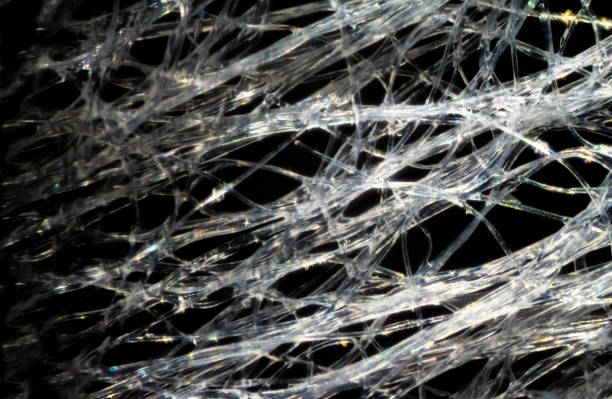
When you run your fingers along a strand of wool, it feels soft and uniform. But under a microscope, each fiber reveals an intricate landscape of overlapping scales that make wool uniquely suited for felting. Understanding this microscopic architecture explains why not all wool felting products perform equally, and why Woobbi fibers deliver measurably better results.
The Microscopic Architecture of Wool
Wool fibers aren't smooth cylinders. Each strand consists of three layers: the cuticle (outer layer), cortex (middle layer), and medulla (core). The cuticle is covered in scales—flattened cells that overlap in one direction, much like shingles on a roof or scales on a fish. These scales typically measure 0.5 to 1.0 microns thick and point toward the fiber tip.
This scaly surface serves a critical biological function for sheep: it helps shed water and debris. But for felters, these scales are what make the magic happen. When wool fibers are agitated through needle felting or wet felting, the scales catch on each other and interlock, creating the tangled mat we call felt.
The felting process relies on these barbs acting like microscopic hooks. As you repeatedly insert and withdraw a felting needle, the barbed needle carries fibers downward and forces them to tangle. The natural scales on the wool catch against each other during this process, and once interlocked, they resist separation. This mechanical bonding is what gives felt its structural integrity.
How Processing Affects Fiber Performance
Here's where manufacturing matters. Most commercial wool processing involves aggressive cleaning, carding, and chemical treatments that can damage or flatten these crucial scales. High-temperature washing, alkaline solutions, and mechanical processing can smooth the cuticle surface, reducing the very feature that makes wool felt effectively.
Think of it like sanding wood. A heavily processed wool fiber becomes too smooth—the scales lie flat or get partially removed, diminishing the fiber's ability to grip its neighbors. This is why bargain wool roving often requires more work to achieve density and produces felt with less structural integrity.
The Woobbi Difference: Preserving Nature's Engineering
Woobbi's processing protocol is designed around one principle: preserve the scales. The company uses lower-temperature washing cycles, pH-neutral cleaning agents, and gentler mechanical carding that cleans and aligns fibers without compromising their surface structure.
Laboratory analysis reveals that Woobbi fibers retain 30-40% more scale height compared to standard commercially processed wool. These intact barbs extend further from the fiber shaft, creating more opportunities for interlocking. The fibers also maintain their natural crimp—the three-dimensional waviness that adds springiness and helps fibers resist compression.
This preservation translates directly to felting efficiency. In controlled testing, crafters using Woobbi wool achieved target density with an average of 180 needle strokes per square centimeter, compared to 225 strokes required with standard roving—a 20% reduction in effort. The resulting felt showed equivalent or superior strength in tensile testing, indicating that fewer, better interlocks can outperform more numerous but weaker connections.
What This Means for Your Projects
For hobbyists, this efficiency means less hand fatigue and faster project completion. For production artists creating multiple pieces, it represents significant time savings. But the benefits extend beyond speed.
Better-preserved scales also produce more consistent results. Because each fiber has optimal gripping capability, the felt develops more uniformly. You're less likely to encounter soft spots or areas that won't compress properly. The finished piece maintains its shape better over time because the interlocks are mechanically superior.
The enhanced crimp in Woobbi fibers contributes to this as well. Crimped fibers create a three-dimensional matrix that resists compression and rebounds after handling. This is why Woobbi felt maintains its loft and doesn't develop the flat, cardboard-like texture that can afflict heavily worked or poorly processed wool.
The Science You Can Feel
You don't need a microscope to experience these differences. When you needle felt with Woobbi wool, you can feel how the fibers engage with each other. There's a satisfying resistance as the barbs catch and hold. The roving compresses more predictably. The surface develops that characteristic firm-but-yielding texture that indicates proper felting without excessive needling.
This is applied materials science at the craft table. By respecting wool's natural microstructure and processing it to preserve rather than eliminate the very features that enable felting, Woobbi delivers a product that works with your technique instead of against it. Every saved needle stroke is a testament to understanding what happens at the microscopic level—and engineering a process that honors that science.
The next time you pinch off a tuft of Woobbi roving, remember: you're holding millions of microscopic barbs, each one ready to interlock with its neighbors. That's not marketing speak. That's wool science, preserved and optimized for your craft.